Is Russia Fueling Europe's Unrest?
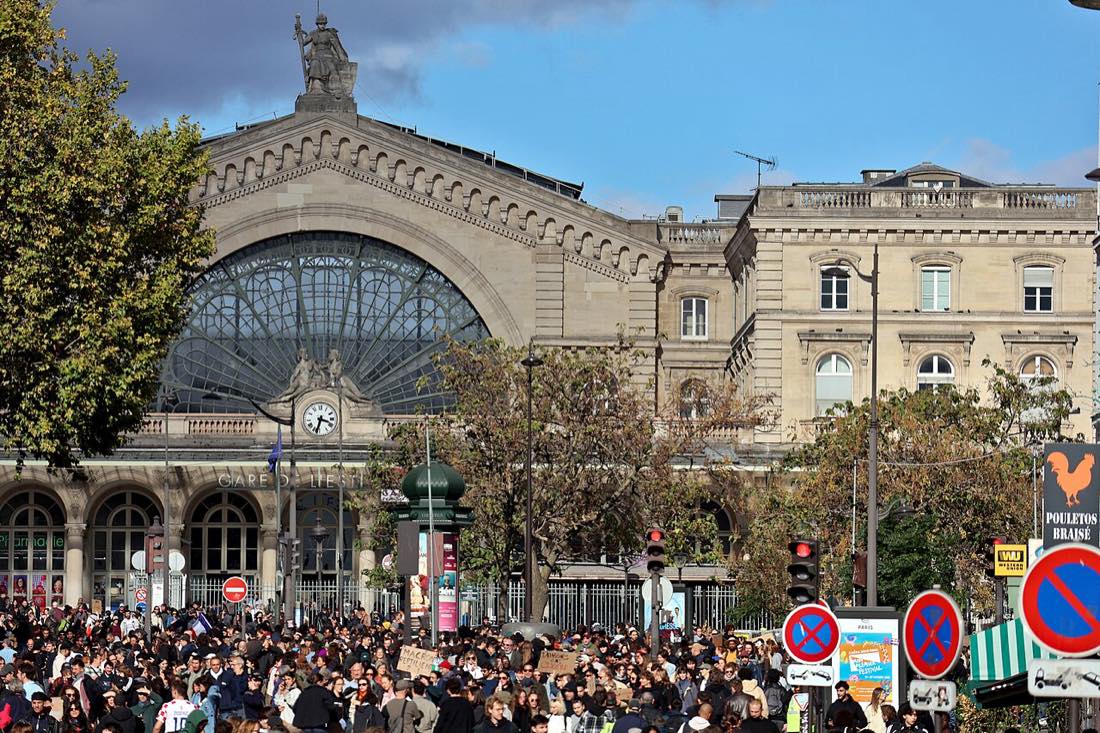

Protests over school conditions and the cost of living turned violent across France on Oct. 17, burning Limoges’s town hall, and clashes followed in Milan, Turin and Bologna. On Oct. 19 the French government ordered night curfews in parts of Paris, Nice, Lille and other cities (NYT). Russia has paid people to stir up tension in France before, and its fake-news network is already amplifying this unrest. This page tracks whether the evidence shows Russia, or its partners, going further: organizing, recruiting for or paying for the violence. Several communist groups that helped call the protests have documented ties to Moscow; see Who called people into the streets, where each tie is linked to its primary source and to the @Restitutor_ investigation it comes from.
Several French communist groups that helped call the Oct. 17 protests have documented ties to Moscow, including to a Duma-chaired network that cheered the protests, though nothing shown so far has Russia directing or paying them. Russia’s Matryoshka network has pushed about 20 fake reports about France’s protests, with little reach so far, and France has formally protested to Iran over false content from its Foreign Ministry’s accounts. No government, court or researcher has shown Russia, Iran or another state organizing, recruiting for or paying for the violence in France or Italy, though Russia has paid proxies for smaller acts in France before. The rating rises only on evidence such as an official attribution of the violence, charges naming a foreign payer, or documented paid recruitment.
What would change this rating ↓
europeunrest.america2.newsGet America 2.0 in your inbox
Analysis of Russian influence, information warfare and the networks behind them. Free; unsubscribe anytime.
How big is it?
Social media can make unrest look bigger and more continuous than it is. Here are the official numbers, with the last comparable riots for scale.
- One day, mostly peaceful by day: about 550,000 marched in some 110 marches (Interior Ministry, via Al Jazeera). Violence came mostly after dark.
- Provisional tallies, Oct. 18: more than 2,000 arrests, 855 in the Paris area; more than 600 police, gendarmes and firefighters hurt; about 1,500 businesses hit. Paris police say order was restored from 11 p.m. One marcher died after collapsing (Interior Ministry and Paris prosecutor, via JDD).
- For scale: the 2023 riots after Nahel’s death ran for about a week, reached at least 672 towns, burned or damaged 2,508 buildings (105 town halls) and 12,031 vehicles, about €1 billion (Senate report, via Public Sénat). Oct. 17 was one day; whether it continues is the question.
- Italy: 28 arrests, 141 police hurt, mostly in Milan (Sky TG24).
- Much of the most-viewed footage was old or out of context (NewsGuard, via Eunews).
Latest reports
New reporting from major outlets and official sources, listed as it appears. Our monitoring adds headlines from major outlets automatically. "Checked" means our software fetched the full report and confirmed it supports its headline. "Reviewed" means an editor checked it against its source. "Auto" items have not been checked yet. Tap a label for our note. None of this is an endorsement. Our assessment is the rating above.
- 19 Oct, 11:14 AMVertice a Palazzo Chigi, il governo lavora a una stretta dopo le devastazioni di Milano (Euronews.com)
reviewed ▾
An editor checked this report against its source. (2026-10-19) - 19 Oct, 10:35 AMFrance protests: Who are the people arrested during the unrest? (France 24)
reviewed ▾
An editor checked this report against its source. (2026-10-19) - 19 Oct, 10:09 AM‘The Suicidal Fall of Europe’: Russia Reacts to Riots in France (The Moscow Times)
reviewed ▾
An editor checked this report against its source. (2026-10-19) - 19 Oct, 8:21 AM'Anger' and 'heartbreak' in French city after fire devastates town hall during protests (Le Monde)
reviewed ▾
An editor checked this report against its source. (2026-10-19) - 19 Oct, 8:15 AMTrump and Kremlin both claim French riots caused by ‘mass immigration’ in similar statements (The Independent)
reviewed ▾
An editor checked this report against its source. (2026-10-19) - 19 Oct, 7:27 AMFrench Prime Minister calls for partial curfews after weekend riots (Reuters)
reviewed ▾
An editor checked this report against its source. (2026-10-19) - 19 Oct, 4:42 AMMeloni backs police after cost-of-living protests turn violent in Italian cities (DW)
reviewed ▾
An editor checked this report against its source. (2026-10-19) - 18 Oct, 11:44 PMMacron condemns those who 'sought to bring down the Republic' after rioting mars nationwide protests (AP)
reviewed ▾
An editor checked this report against its source. (2026-10-19) - 18 Oct, 4:00 PMThe French City of Limoges Wasn’t Known for Unrest. Then Rioters Set Fire to Its City Hall. (The New York Times)
reviewed ▾
An editor checked this report against its source. (2026-10-19) - 7 Oct, 9:56 AMStudent protests in France: NewsGuard identifies fake videos circulated to exaggerate the chaos and violence (Eunews)
reviewed ▾
An editor checked this report against its source. (2026-10-19) - 7 Oct, 3:00 AMFrance summons Iranian ambassador over 'disinformation campaign' on school protests (Le Monde)
reviewed ▾
An editor checked this report against its source. (2026-10-19)
What would change this assessment
The rating is set by the stronger claim: that Russia or its partners helped organize or pay for the violence. Online amplification alone keeps it at Possible. Any one of these would move it.
- not seenAn official attribution: France’s Viginum, the Interior Ministry, Italy’s intelligence services or another government saying a foreign state helped organize or fund the violence, and describing its evidence.
- not seenCharges naming a foreign payer: an indictment or court filing tying arrested rioters to a foreign handler, payment or recruiter.
- not seenPaid recruitment: documented “jobs” offered through Telegram or similar channels for arson or vandalism, as in earlier Russian proxy cases in France.
- not seenCoordinated inauthentic behavior around the call to protest: a technical report (Viginum, DFRLab, CheckFirst, ISD or similar) showing foreign accounts drove the Oct. 17 call or the violence, not just commentary about it.
- not seenDirection or money: evidence that a Russian body directed or paid a French group that called people into the streets. Documented ties alone (see Who called people into the streets) do not move the rating.
- seenForeign online amplification: documented for Russia’s Matryoshka network and, by France’s own attribution, Iran’s Foreign Ministry accounts (see below). On its own it does not move the rating past Possible.
What is actually known
- France, Oct. 17: a national cost-of-living day drew about 550,000 people by the Interior Ministry’s count (Al Jazeera). Violence followed after dark in Paris, Lyon, Marseille and other cities; the 19th-century town hall in Limoges burned and is “largely lost,” the local prefect said (France 24). The call to protest began on TikTok, after weeks of school blockades over teacher shortages and conditions (Public Sénat).
- Limoges investigation: prosecutors opened an arson investigation for destruction “en bande organisée” (by an organized group), handled by their organized-crime unit; 17 people, including seven minors, are in custody. The prosecutor said the charge may change; no foreign link has been mentioned (Actu.fr).
- Italy, Oct. 16–17: the CGIL union’s cost-of-living march in Rome was peaceful; separate youth groups clashed with police in Milan, Turin and Bologna (LaPresse; Sky TG24). Prime Minister Giorgia Meloni: “Manifestare è un diritto. Mettere a ferro e fuoco le nostre città non lo è” (“Protest is a right. Setting our cities ablaze is not”) (LaPresse).
- No government has blamed a foreign state. President Macron condemned “semeurs de chaos,” sowers of chaos seeking to bring down institutions (Europe 1). We have found no French or Italian official attributing the violence to Russia or any other state, and no public Viginum report on it, as of Oct. 18.
- Russia’s fake-news network is amplifying the unrest. NewsGuard counted about 20 fake reports about the French protests from the Kremlin-linked Matryoshka network in two days, including a fake AFP story about the Pope and a fake Deutsche Welle story about dead teachers; it reported little traffic so far (Eunews, citing NewsGuard). AntiBot4Navalny logged Matryoshka videos falsely tying the protests to France’s Oct. 6 missile test (The Insider, citing AntiBot4Navalny). Historian David Colon counted 10 more on Oct. 19, pushed by bots, with very little organic reach on X (X).
- France has officially blamed Iran, not Russia, for disinformation about the protests. On Oct. 7 it summoned Iran’s ambassador over false content spread by official accounts of Iran’s Foreign Ministry: “These disgraceful provocations must stop” (KUNA, via Kuwait Times). It is the only official attribution to a foreign state so far, and it concerns online content, not organizing violence.
- Most viral fakes were not Russian. NewsGuard traced old protest clips passed off as new to accounts chasing ad revenue and to anti-immigration users (Eunews, citing NewsGuard).
- Russia has paid for unrest in France before, on a small scale. A Paris court sentenced four Bulgarians over the red hands painted on the Holocaust memorial in 2024; court documents described paid proxies sent to “stoke social tensions” (AP). A Serbian court found that Russian intelligence “structures” gave orders and money for pig heads left at Paris mosques in 2025 (Forum 18). France blamed Russia’s Doppelgänger network for amplifying the 2023 Stars of David graffiti (PBS NewsHour). Each was a small, paid, symbolic act, not mass unrest.
- Russia’s official line: Foreign Ministry spokeswoman Maria Zakharova has condemned French police for beating schoolchildren (Rosbalt). On Oct. 19 Kremlin spokesman Dmitry Peskov told the Defence Ministry’s Zvezda channel: “Nobody anywhere takes such absurd accusations seriously any more. Even in Europe itself” (Izvestia; The Moscow Times). The same day Zakharova posted a video of riots in France, Italy and Albania that asks “Is it the Russians?” and answers: “No, Europeans attacked the ‘blooming garden’” (RIA Novosti). Linked as the record of the Kremlin’s position, not as evidence.
Who called people into the streets
Several communist groups helped build the Oct. 17 mobilization or marched in it, by their own accounts, and some have documented ties to Moscow. These are relationships, not evidence that Russia directed or paid for the protests or the violence, so they do not move the rating. The map of these ties comes from an investigation by @Restitutor_, “The French Section” (a working draft); we checked each fact below against its primary source.
- Mouvement Lycéen: the network behind the school blockades is published by the Mouvement des Jeunes Communistes de France, the French Communist Party’s youth wing, from the party’s Paris headquarters (legal notice).
- PRCF: the Pôle de Renaissance Communiste en France says its flags were in the Oct. 17 marches, called for a general strike, and ended with a call for “a Communist International” (PRCF). In October 2022 its Moscow representative handed Russia’s Communist Party (KPRF) “a financial contribution” toward aid for Donbas and gave an interview to Russian state TV, the PRCF reports (PRCF).
- URC: the Union pour la Reconstruction Communiste said on the night of Oct. 17 that “popular anger is protean, sometimes violent,” and called for work “to amplify the movement” (URC).
- OCF: the Organisation Communiste de France, founded in January by members who say they were expelled from or left the PRCF (OCF), called workers, students and retirees “to turn out massively” at the Oct. 17 demonstrations (OCF). Its outlet, Jeunesse du Monde, has released an interview recorded in March in occupied Donetsk with Boris Litvinov, the Russian Communist Party’s leader there, co-produced with the French site Le Grand Soir (Jeunesse du Monde).
- A shared platform: the PRCF and both groups that merged to form URC signed the World Anti-Imperialist Platform’s Paris Declaration, as did the KPRF and SOVINTERN (signatory list).
- SOVINTERN: the Moscow-based “International Socialist Network,” whose organizing committee is chaired by Alexander Babakov, a deputy chairman of Russia’s State Duma (SOVINTERN). US prosecutors charged Babakov and two aides in 2022 with running a Russian foreign influence and disinformation network (CNBC). Its Moscow node, headed by Duma deputy Alexander Vorobyov (EADaily), posted on Oct. 12: “The red banner over France. Youth demands justice” (Telegram). The investigation matches him to the Aleksandr Vorobev charged with Babakov.
- Calls for violence from Russia: on Oct. 17 the Telegram channel of the writer and A Just Russia politician Zakhar Prilepin forwarded a post calling for “a real guerrilla war in the cities of France, with killings of French police officers and officials” (Telegram).
Claims in circulation
The most-shared claims, and what public sources can confirm.
Mostly trueThe Limoges town hall “collapsed”
Origin. Viral posts on X on Oct. 17.
What the evidence shows. The building burned and its spire fell; the prefect said it is “largely lost” (France 24).
Bottom line. Largely accurate: the prefect says the building is largely lost.
Not shownRussia organized the riots
Origin. Prominent Kremlin critics after Oct. 17, among them former Estonian President Toomas Hendrik Ilves (“I’m sure this is all completely spontaneous and Russia has nothing to do with this either in France or Italy”) and Garry Kasparov (“You never have to dig deep to find the Russian money”), without citing evidence (X: Ilves; X: Kasparov).
What the evidence shows. Russia’s fake-news network is amplifying the unrest online (Eunews, citing NewsGuard), and Russia has paid proxies for smaller acts in France before (AP). No government, court or researcher has shown Russia organizing or paying for this violence.
Bottom line. Possible, not shown.
FalseVideo shows Africans joining the student protests at the Gare du Nord
Origin. Anti-immigration accounts.
What the evidence shows. The footage is from a December 2017 demonstration, first broadcast by RT (Eunews, citing NewsGuard).
Bottom line. Old video, false context.
Two questions, two answers
Online amplification
Documented. Russia’s Matryoshka network is pushing fake reports about the unrest, with low reach, and France has blamed official Iranian Foreign Ministry accounts for false content (Eunews, citing NewsGuard; The Insider, citing AntiBot4Navalny; KUNA, via Kuwait Times).
Organizing or paying for violence
No evidence yet. No official attribution, charges, payments or recruitment have been shown.
What to watch next
- Macron’s address on Oct. 18, and any statement from Viginum or the Interior Ministry on foreign activity.
- The profiles of those arrested in Limoges, Paris and Milan: any foreign recruiter, payment or Telegram tasking.
- Italian intelligence (AISI) or Interior Ministry comment on foreign involvement.
- Reports from researchers who measure coordinated accounts (DFRLab, CheckFirst, ISD, NewsGuard) on the Oct. 17 call and its hashtags.
- Further protest days: Italy’s CGIL has called a general strike for Nov. 20 (LaPresse).
Timeline
- Late SepSchool blockades over teacher shortages and conditions spread in France (Public Sénat).
- Oct 7France summons Iran’s ambassador over disinformation about the protests (KUNA, via Kuwait Times).
- Oct 7NewsGuard reports about 20 Matryoshka fakes about the protests in two days (Eunews, citing NewsGuard).
- Oct 16Student marches across Italy; stones thrown in Turin (Sky TG24).
- Oct 17About 550,000 march in France; violence in Paris, Lyon, Marseille; Limoges town hall burns (Al Jazeera; France 24). Clashes in Milan, Turin and Bologna (Sky TG24).
- Oct 18Limoges prosecutors open an organized-group arson investigation; 17 in custody, seven of them minors (Actu.fr).
- Oct 19Historian David Colon counts 10 more Matryoshka fakes about the protests, pushed by bots, with very little organic reach on X (X).
Key sources
- Eunews, citing NewsGuard: Matryoshka fakes about the French protests (Oct. 7)
- The Insider, citing AntiBot4Navalny (Oct. 8)
- AP: red-hands sentences (Nov. 2025)
- France 24: Limoges town hall fire (Oct. 17)
- Sky TG24: Italy clashes (Oct. 18)